Here are a couple photos of Natalie...
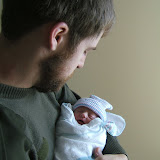

Goddaughter-elect
I got some very exciting news four o'clock yesterday afternoon--my goddaughter-elect, Natalie Grace, was born, an unexpected month early! The doctors say her vital signs are good even though she's only 4.5 pounds heavy (for comparison, I was a whopping 9 pounds, 7 ounces when I showed up a month late lo some 23 years ago). But the doctors say her vital signs are good, so they don't foresee any problems.
Conveniently, I was going Christmas shopping last night; I only ended up buying things for my godchild (Hana) and godchild-elect (Natalie), because they're the fun ones to shop for (but I'm on track and know what I need to get for everyone else). I'd write about the things I got them, because they're really cute and exciting, but I can't blog about them until after Christmas, in case they (or their parents) check blogs before then. ;)
The plan is to go visit Natalie tomorrow afternoon, and then go up again in a few weeks for the baptism. Ask my housemates, and you'll know that I'm a very proud godparent and love bragging about or showing off pictures of my little ones, so this is a very exciting time for me! (Sorry, no pictures yet; I'll try to post as soon as some arrive at my inbox).
Islam, Modernity, and Us
Still not sure if anyone actually reads this thing, but every now and then I get an email from someone referring to a post of several months ago, so I guess I should at least seasonally update my blog. Last weekend was quite busy for me; I was at Notre Dame for the Center for Ethics and Culture's annual fall conference, "Modernity: Yearning for the Infinite," then for our regional Communion and Liberation Advent retreat. So here is one reflection that struck me from the conference (although there are many more insights offered by speakers or in conversation that I won't be listing here). I may post a reflection from the second keynote, by Paul Griffiths, later this week or next.
First, the conference began with Professor MacIntyre's keynote, "Islam, Modernity, and Us." His provocative thesis was that when we talk about Islam, we're talking about ourselves, because we as Christians strive to engage modernity, which is ambivalent toward religious claims. While modernity is not irreligious, it offers a circumscribed space in which to practice one's faith, provided religion does not threaten the boundaries of other elements of modern life, such as politics and technology. In fact, modernity tends to fragment life, such that my work life is distinct from my personal life, and both from political or biological life; there is no public forum in which to ask what is the good for me, or for us, qua human beings, which religion tries to do. Instead, markets operate by independent, amoral norms; as for technology, what can be done may, indeed should, be done; and the limitations of our politics are taken as a given, even if perhaps modern democratic politics cannot adequately address today's most pressing issues. Each of these fields is taken as self-justifying and autonomous, without facing real, critical challenges in the public sphere (universities don't count).
As religions try to adapt to modernity, an easy impulse is to assimilate, accepting a truncated version of themselves that keeps them from genuinely challenging the established order. As believers become dissatisfied with restrictions on their freedom, they might rebel, rejecting the modern project altogether and seeking refuge in an ahistorical, fundamentalist version of faith (I'm reminded of the imam's city of halted clocks in Salman Rushdie's Satanic Verses). In promoting a purportedly pure, absolute faith, "the other" becomes evil, and violence ensues. These two options, I think, are the most common because they are easy. Religious people are either secularists dressed in religious garb, or artifacts enshrined in a museum, which lose their meaning because they have lost their context.
The via tertia (not a via media) that MacIntyre endorses seeks to create a space in which revelation is brought into conversation with reason and all the evidences at our disposal; a locus at which every aspect of my life can be discussed not as it relates to my prescribed, delineated roles, but as it relates to me, in a holistic sense. MacIntyre talked about a movement of Muslim women in Egypt who have begun gathering together to discuss ideas or their own conduct, even, for example, how they should dress in public. Each contribution to these meetings is expected to be defended rationally, yet they also insist on engagement with religious tradition. One can see these movements in the Catholic Church as well, such as in Communion and Liberation.
As to how these movements challenge the established order, I'm not sure. I don't think anyone should feel particularly threatened by the fact there are citizens taking their lives and actions seriously. But then again, they are radical precisely because they put on the table questions that might make me limit or revise my use of certain technologies, or my conduct at work, or I might just become a gadfly that puts a challenging question on the table now and then. What's truly revolutionary, however, is the change that such movements can accomplish in individuals; and every shift in character and identity has its ripple effect on communities. A friend asked me over lunch at the conference, if I were to found a revolutionary society, what cause I would choose, what I would fight against. My first thought was that I would wage a war against myself, a space where I could challenge myself and others to examine critically our lives and to make a real, persistent effort to live authentically, reasonably, and faithfully. This project is important for me because I find that it's much easier to identify and affirm the truth, than to care about it; and if I don't care, why should I expect others to? As far as my actions are concerned, only a change in me really change the world. Furthermore, finding peace within empowers us to advocate the right causes well, because we are freed from anxiety and insecurity about who we are.
Second, movements to dilate reason and begin a conversation with faith also make room for cross-cultural dialogue. As long as religion is invited to the table only after it is crippled by external restrictions, there is no room for dialogue, because religion will not be taken seriously. There is a toleration more dangerous than hostility, for some kinds of toleration allow me to think and say whatever I want, and people will tell me "That's an interesting thought," or "Good for you!", but will never accept a challenge that threatens their way of life; at least those who are hostile perceive, and must come to terms with, the offense. It's a goal of mine to take part some day in an interreligious network between Christian, Jewish, and Muslim movements that take faith and reason seriously, because a forum such as that is perhaps the best chance we have for true dialogue today.
Forgotten Wars
I've been reading a fascinating book by French philosopher Bernard-Henri Levy, who pretty much parachuted into five of today's worst warzones: Sri Lanka, South Sudan, Burundi, Angola, and Colombia (War, Evil, and the End of History). What distinguishes these wars is that, unlike our grand, world-shaping battles, they have no meaning. No battle for the soul of Islam, no clash of civilizations, no confrontation of ideologies. Rather, children are pressed into military service, and innocent people live aware that no one cares whether they live or die, nor will anyone know their fate. How will a massacre of a rural African village affect me? How will the success or failure of a rebel militia affect the course of world history? The global implications of battles involving the West and radical Islam are clear, or if not clear, at least certain. The forgotten wars, however, have no implications.
Sri Lanka has been in the news recently, because violence has re-erupted between the Tamils and the Sindhalese. I read an article about some Catholic priests who have been rushing around their village trying to protect civilians of all faiths (Christians are a small minority; the ethnic conflict is between Hindus and Buddhists, with neutral Christians and, believe it or not, Muslims caught in the crossfire of terrorism). A priest called out to the world, "We are heading towards an isolated, unknown and silent death. Are we going to be a people forgotten? Not cared for? Is the World going to keep silent now and count on our bones from mass graves to sit on judgment? How will the international community especially the European Union, Co-Chairs, and Peace envoys of Norway and Japan be indifferent when innocent, unarmed, people are systematically decimated." Apparently, one priest, who witnessed the massacre of 15 people he was sheltering in his Church, has recently disappeared.
As a catechetical minister in the states, this story struck me inasmuch as it contrasts with the ease of my ministry. I spend my time planning discussions on social justice, catechizing new Christians, or discussing Scripture with high school students at Starbucks. Surely these activities fulfill some needs of the Church where I am placed. But in Sri Lanka, ministers are doing all they can just to preserve life in an inescapable hell. It's tremendously difficult for me to imagine a genuinely life-or-death ministerial situation. I try to instill in all to whom I minister the conviction that they are created in the image of God, that their lives and choices have meaning and implications. How could I do that when faced with a society that utterly disregards human life, or a world that ignores the deaths of so many? How could I find God and show him to my parish when my people were living as a people damned--unnamed, forgotten, and of no consequence any longer?
While I can think of no practical responses I can initiate (any suggestions?), I do recall Paul's admonishment: "God has so constructed the body as to give greater honor to a part that is without honor, so that there may be no division in the body, but that the parts may have the same concern for one another. If one part suffers, all the parts suffer with it; if one part is honored, all the parts share its joy" (1 Corinthians 12:24-26). Events in the Sri Lankan Church are just significant as events in the American Church, where we concern ourselves with things of greater (practical) consequence, things that actually have effects; somehow I wonder if what happens in forgotten regions, where our voice is of no practical significance, is in fact of greater consequence, for our words and actions in those regions interrupt, however quietly, the darkness of hell. (I wonder: How is the work of Christians in those forgotten parts of the world perceived?) Who are we to say that pivotal events in our history are also pivotal eschatological, when perhaps the suffering of those abandoned to violence, of those remembered only by a God who seems not to care, is more eschatologically definitive. That is, our response to the forgotten might more deeply define our world and our humanity than does the outcome of the great wars going on today. I can't do much for the forgotten, but a first step is to practice greater solidarity, at least in prayer, with all "the damned," all those meaningless victims of meaningless violence, who cannot even console themselves that their annihilation--whether by physical death or dehumanization or utter loss of agency--is in service of some greater cause. I can at least listen to the voiceless, and begin to give them a voice....
Subscribe to:
Posts (Atom)
The art of empathy in dramatic times
Over the past few years, my wife Christina and I have gotten involved in local theater (in the audience only - no auditions...yet!). I love ...
