Dear visitors,
Just to let you know, I've got a lot on my plate right now, so I am taking a break from my blog. If you want, please check back after Easter.
Thanks!
Ky

Tariq Ramadan, Swing Dancing, and the Village People
I had an eventful weekend, with highlights including swing dancing Friday night with a live band, distributing Valentine's Day gifts with my parish's confirmandi to the elderly at American Village, a nearby nursing home (they're affectionately know as "the Village People"), braving the cold for a couple runs, and plenty of relaxing. The nursing home visit was really quite good, and I'm thinking about offering to distribute ashes to the residents next Wednesday, because some were asking about that. They really enjoyed the visit.
I officially finished my course of "Beginners" Latin study, so I'm moving on to working my way through Caesar's De bello gallico. In the course of my study, I discovered that I really enjoy learning foreign languages, which has apparently become a hobby of mine. I'm thinking about returning to Knoxville next summer for a part time job that would leave me time to take a course in Spanish or German at UT. German would help me in grad school, but I've found I mostly know languages that other people I meet don't know. I often meet Spanish- or Italian-speakers from Europe or Central/South America, but I speak neither of those languages. To be more hospitable to the folks I meet in the states, I'd really like to learn one of those languages, even though neither would help me much in my future studies. After learning Latin, a more practical language might be a good step.
Finally, I've started reading Tariq Ramadan's Western Muslims and the Future of Islam (another great find in a used bookstore). For those who don't know, Tariq was received a faculty appointment at Notre Dame, only to be denied a Visa to the US after a lot of dilatory tactics at the Department of State. Reading his book, I'm very disappointed he couldn't be part of life at Notre Dame, because his goals resonate well with Notre Dame's. Both are attempting to articulate a method of expressing the fullness of their respective faiths in an often antagonistic culture. Surprisingly, I have found that the two people I'm most reminded of in reading Tariq are Professor MacIntyre (in his remarks on "Islam, Modernity, and Us") and Pope Benedict (in his insistence on reason). Tariq outlines, among the basic principles of Islam, that God is transcendent and creator; that his dominion, and that of his Revelation, is universal in scope; that all creation is "Islamic," that is, submissive to God's will, and thus a source of Revelation; and that human beings are incomplete and thus yearn for completion and fulfillment in God alone. Of course, though each of these themes have their counterparts in Christianity, there are substantial differences, also in the anthropologies and philosophies of Islam and Christianity, but Tariq's account of Islam is thoroughly reasonable. Naturally, he misunderstands Christianity in many of the ways I would expect him to, but so has Benedict "brusquely" treated Islam here or there. Let me offer one excerpt from Western Muslims:
I officially finished my course of "Beginners" Latin study, so I'm moving on to working my way through Caesar's De bello gallico. In the course of my study, I discovered that I really enjoy learning foreign languages, which has apparently become a hobby of mine. I'm thinking about returning to Knoxville next summer for a part time job that would leave me time to take a course in Spanish or German at UT. German would help me in grad school, but I've found I mostly know languages that other people I meet don't know. I often meet Spanish- or Italian-speakers from Europe or Central/South America, but I speak neither of those languages. To be more hospitable to the folks I meet in the states, I'd really like to learn one of those languages, even though neither would help me much in my future studies. After learning Latin, a more practical language might be a good step.
Finally, I've started reading Tariq Ramadan's Western Muslims and the Future of Islam (another great find in a used bookstore). For those who don't know, Tariq was received a faculty appointment at Notre Dame, only to be denied a Visa to the US after a lot of dilatory tactics at the Department of State. Reading his book, I'm very disappointed he couldn't be part of life at Notre Dame, because his goals resonate well with Notre Dame's. Both are attempting to articulate a method of expressing the fullness of their respective faiths in an often antagonistic culture. Surprisingly, I have found that the two people I'm most reminded of in reading Tariq are Professor MacIntyre (in his remarks on "Islam, Modernity, and Us") and Pope Benedict (in his insistence on reason). Tariq outlines, among the basic principles of Islam, that God is transcendent and creator; that his dominion, and that of his Revelation, is universal in scope; that all creation is "Islamic," that is, submissive to God's will, and thus a source of Revelation; and that human beings are incomplete and thus yearn for completion and fulfillment in God alone. Of course, though each of these themes have their counterparts in Christianity, there are substantial differences, also in the anthropologies and philosophies of Islam and Christianity, but Tariq's account of Islam is thoroughly reasonable. Naturally, he misunderstands Christianity in many of the ways I would expect him to, but so has Benedict "brusquely" treated Islam here or there. Let me offer one excerpt from Western Muslims:
A living faith makes it possible for the intellect to accept signs beyond simple elements of nature, and active reason makes it possible for faith to understand and also to acquire more self-understanding, and in that way to draw closer to the divine: "Of all the servants, those who know are those who are open to the intimate awareness of God." Blaise Pascal had an apt expression: "The heart has reasons that reason does not know," thus differentiating the two realms of faith and reason (even though this formula has often been--wrongly--reduced to an opposition between the emotional and the rational). From an Islamic point of view, the relationship between the heart (where the first longing, the first breath toward faith takes place) and the intellect (which responds to the call of this breath and takes up the quest) might rather be expressed this way: the heart has reasons that reason will recognize. Apart from the expression, the difference is profound.I am eager to see Tariq's practical insights about Muslim life in Western Society, which he intends to expound in the second half of the book, after outlining the fundamental principles of Islam in the first. And I'm still kind of upset with the State Department.
Blood Diamond
Saturday night, I saw a very intense, but very well done, movie: Blood Diamond.
If you can handle so much gore (really, you're not supposed to be able to handle it), Blood Diamond conveys powerful themes. It effectively juxtaposes western comfort and abstraction with the hell on which it often depends. The opening scene, for example, flashes between a rebel raid on a Sierra Leon village and a three-piece-suit UN meeting on curbing the flow of conflict diamonds. The western response was farcically disproportionate to reality.
Basically, the movie was about exploitation: of civilians, of the land, of the poor. Often, movies about social justice issues turn out too Michael-Moore-esque, a fate that Blood Diamond avoids. It is not about blaming everyone in particular, or simply conveying a political message; rather, it examines the sordid reality we all inhabit, whether knowingly or unwittingly. In the course of the film, two of the three protagonist discovered how he or she exploited the agony of others; they lived off of hell, either by fueling it or sensationalizing it (through journalism). This they discovered not on a geopolitical level alone, but through their personal interactions with those around them. The third protagonist, one of the damned condemned to hell by forces beyond his control, shone as a ray of hope and redemption. The personal microcosm that made the movie so engaging resonated with my conviction that, when dealing with social justice issues, we must examine our own activity according to the principles with which we critique society: am I looking out for the weakest among us? do I welcome the marginalized among my neighbors? do I encourage others to freely and creatively use their gifts?
Final thought: the movie made me return to an excellent book I read over the summer: War, Evil, and the End of History by Bernard-Henri Levy. This was quite a find in a used bookstore a year ago. Henri-Levy, a French professor of philosophy, parachuted into some of the darkest conflict zones in the world (Angola, Burundi, Sri Lanka, Sudan, and Columbia). There, he interviewed suicide bombers, child soldiers, derelict civilians, and drug lords (it's from his book that I borrow the language of "hell" and "the damned" that I use above; they refer to a place or persons which have lost all meaning, all continuity with the past, all presence today, and all hope for the future). Henri-Levy's mission, as he discovered it in writing his book, was to give voice to those ghosts, not in general (westerners are fond of generalities, which are more comfortable and manageable than personalities), but in particular. In this way, he could give the people he met a small purpose and meaning in life, because someone else would listen to them. By having an audience, they discover their story. His "adventures," as he called them, also shook him out of the comfortable theories of the West by literally dropping him into a world where every neat philosophy he had ever taught went up in smoke. "Evil," in these conflict zones, is not an archaic religious idea, or an event overcome by democracy and human rights, or a matter of perspective; nor are passion and commitment always good, nor are the conquered always victims; evil is not an idea at all, but a reality, or, better yet, a non-reality, for it obliterates reality. It infects those with power, crushes those indifferent to it or powerless before it, enlists the naive, and negates everyone. Without warning, it destroys cities, towns, and families, leaving living ghosts to wander amid the rubble of their lives that will never be rebuilt. Without facing this "reality," we cannot understand redemption or envision its surprising possibility. I am thankful that a movie like Blood Diamond can put us, even for only two hours, in a world where our assumptions and values are sorely put to the test.
If you can handle so much gore (really, you're not supposed to be able to handle it), Blood Diamond conveys powerful themes. It effectively juxtaposes western comfort and abstraction with the hell on which it often depends. The opening scene, for example, flashes between a rebel raid on a Sierra Leon village and a three-piece-suit UN meeting on curbing the flow of conflict diamonds. The western response was farcically disproportionate to reality.
Basically, the movie was about exploitation: of civilians, of the land, of the poor. Often, movies about social justice issues turn out too Michael-Moore-esque, a fate that Blood Diamond avoids. It is not about blaming everyone in particular, or simply conveying a political message; rather, it examines the sordid reality we all inhabit, whether knowingly or unwittingly. In the course of the film, two of the three protagonist discovered how he or she exploited the agony of others; they lived off of hell, either by fueling it or sensationalizing it (through journalism). This they discovered not on a geopolitical level alone, but through their personal interactions with those around them. The third protagonist, one of the damned condemned to hell by forces beyond his control, shone as a ray of hope and redemption. The personal microcosm that made the movie so engaging resonated with my conviction that, when dealing with social justice issues, we must examine our own activity according to the principles with which we critique society: am I looking out for the weakest among us? do I welcome the marginalized among my neighbors? do I encourage others to freely and creatively use their gifts?
Final thought: the movie made me return to an excellent book I read over the summer: War, Evil, and the End of History by Bernard-Henri Levy. This was quite a find in a used bookstore a year ago. Henri-Levy, a French professor of philosophy, parachuted into some of the darkest conflict zones in the world (Angola, Burundi, Sri Lanka, Sudan, and Columbia). There, he interviewed suicide bombers, child soldiers, derelict civilians, and drug lords (it's from his book that I borrow the language of "hell" and "the damned" that I use above; they refer to a place or persons which have lost all meaning, all continuity with the past, all presence today, and all hope for the future). Henri-Levy's mission, as he discovered it in writing his book, was to give voice to those ghosts, not in general (westerners are fond of generalities, which are more comfortable and manageable than personalities), but in particular. In this way, he could give the people he met a small purpose and meaning in life, because someone else would listen to them. By having an audience, they discover their story. His "adventures," as he called them, also shook him out of the comfortable theories of the West by literally dropping him into a world where every neat philosophy he had ever taught went up in smoke. "Evil," in these conflict zones, is not an archaic religious idea, or an event overcome by democracy and human rights, or a matter of perspective; nor are passion and commitment always good, nor are the conquered always victims; evil is not an idea at all, but a reality, or, better yet, a non-reality, for it obliterates reality. It infects those with power, crushes those indifferent to it or powerless before it, enlists the naive, and negates everyone. Without warning, it destroys cities, towns, and families, leaving living ghosts to wander amid the rubble of their lives that will never be rebuilt. Without facing this "reality," we cannot understand redemption or envision its surprising possibility. I am thankful that a movie like Blood Diamond can put us, even for only two hours, in a world where our assumptions and values are sorely put to the test.
Minding Other People's Business
Why Do Good? Brain Study Offers Clues - Forbes.com
I came across this very interesting article in Forbes the other day. It reports a recent study on the neurophysiology of "altruism." The researchers designed an experiment to see what regions of the brain increased in activity in altruistic people, as opposed to selfish people, upon seeing something good happen to someone else. They hypothesized that the "warm and fuzzy" department would increase activity, that is, the region associated with pleasure and reward. This would support the belief I've often heard that all love and service is really self-serving; I help other people because it feels good, or because it gives me something to be proud about.
Surprisingly, the study found that it is not the reward system, but the system that responds to meaningful stimuli in the environment, which is active, for example, when I see something threatening to me. Under the constraints of the experiment, this region was much more active in those who exhibited unselfish than in those who were selfish.
What motivates people to do good, the study suggests, is not self-satisfaction, but a deep, even primal solidarity by which I identify with a neighbor, realizing that "that could have been me." I haven't read the full study, only the report in Forbes, but it leaves me with some new questions. Here are a couple.
What I would study if I were a neurologist:
1) What trains or cultivates the region of the brain in question so that one responds to situations others face? Personal tragedy? Service work?
2) "Altruism" (there must be a more profound word they could have used!) often moves us to make costly sacrifices. How do ascetic practices, such as fasting, affect this region of the brain?
3) How much depends on genetics? How much on the way a child is raised?
Anyway, I was pretty pleased to see that a new scientific study is challenging the widespread assumptions of rational choice theory. Perhaps it will turn out that humans are even biologically a bit deeper than modern economics suggests.
I came across this very interesting article in Forbes the other day. It reports a recent study on the neurophysiology of "altruism." The researchers designed an experiment to see what regions of the brain increased in activity in altruistic people, as opposed to selfish people, upon seeing something good happen to someone else. They hypothesized that the "warm and fuzzy" department would increase activity, that is, the region associated with pleasure and reward. This would support the belief I've often heard that all love and service is really self-serving; I help other people because it feels good, or because it gives me something to be proud about.
Surprisingly, the study found that it is not the reward system, but the system that responds to meaningful stimuli in the environment, which is active, for example, when I see something threatening to me. Under the constraints of the experiment, this region was much more active in those who exhibited unselfish than in those who were selfish.
What motivates people to do good, the study suggests, is not self-satisfaction, but a deep, even primal solidarity by which I identify with a neighbor, realizing that "that could have been me." I haven't read the full study, only the report in Forbes, but it leaves me with some new questions. Here are a couple.
What I would study if I were a neurologist:
1) What trains or cultivates the region of the brain in question so that one responds to situations others face? Personal tragedy? Service work?
2) "Altruism" (there must be a more profound word they could have used!) often moves us to make costly sacrifices. How do ascetic practices, such as fasting, affect this region of the brain?
3) How much depends on genetics? How much on the way a child is raised?
Anyway, I was pretty pleased to see that a new scientific study is challenging the widespread assumptions of rational choice theory. Perhaps it will turn out that humans are even biologically a bit deeper than modern economics suggests.
Natalie's Big Day
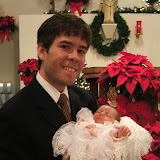
Natalie's Baptism
Finally! I've got photos up from Natalie's baptism (plus a few bonus photos from other times during her 7 weeks so far on this side of the womb.
International Blog of Mystery
After putting a counter on my blog a couple months ago, I was excited when, checking statistics yesterday, I discovered that my blog has been visited by two people each from Canada and Sweden!
In other news, I'm signing off today to go on retreat this weekend (I'm about ready for a retreat, too), so I won't post again until sometime next week.
In other news, I'm signing off today to go on retreat this weekend (I'm about ready for a retreat, too), so I won't post again until sometime next week.
Shout outs
Just a couple shout-outs before I get back to work.
A tip of the hat to the Colts, super-bowl bound finally. If you didn't see the game last night, it was a great one. We had an impromptu game watch party at my house last night, and it was much fun, so I think it might be a precursor to a Superbowl party two weeks from now!
Tip of the hat to my new favorite flight site, www.kayak.com, which searches hundreds of other flights to find you the best deals, emails you when better deals come up, and offers graphs of fare trends so you know when a good time to buy is. I got my ticket to Florida for my goddaughter Hana's first birthday party there, and I'm officially a fan.
Finally, a tip of the hat to being done with graduate school applications! The last one is officially stamped, sealed, and [being] delivered! For those who haven't been keeping up with my future plans, I'm applying to doctoral programs in theology at U of Chicago, Boston College, Fordham, and Marquette. Apps were due between December and February. I'm glad I don't have to think about applications for a while, but I feel like I'm back in high school; even though I'm not expecting to hear back from anywhere until early March, I am always eager to check the mail when I get home from work, just in case... I'll keep folks posted here as I hear back, especially if it's good news.
And now, back to work.
A tip of the hat to the Colts, super-bowl bound finally. If you didn't see the game last night, it was a great one. We had an impromptu game watch party at my house last night, and it was much fun, so I think it might be a precursor to a Superbowl party two weeks from now!
Tip of the hat to my new favorite flight site, www.kayak.com, which searches hundreds of other flights to find you the best deals, emails you when better deals come up, and offers graphs of fare trends so you know when a good time to buy is. I got my ticket to Florida for my goddaughter Hana's first birthday party there, and I'm officially a fan.
Finally, a tip of the hat to being done with graduate school applications! The last one is officially stamped, sealed, and [being] delivered! For those who haven't been keeping up with my future plans, I'm applying to doctoral programs in theology at U of Chicago, Boston College, Fordham, and Marquette. Apps were due between December and February. I'm glad I don't have to think about applications for a while, but I feel like I'm back in high school; even though I'm not expecting to hear back from anywhere until early March, I am always eager to check the mail when I get home from work, just in case... I'll keep folks posted here as I hear back, especially if it's good news.
And now, back to work.
Sanctus Morus: Divine Folly as Public Reason
After a few personal notes in the last few posts, I guess it's time for me to post a meatier essay, but not before I assure you that Natalie Grace was baptized Sunday, and she did very well. I'll post pictures as soon as Aaron emails them to me.
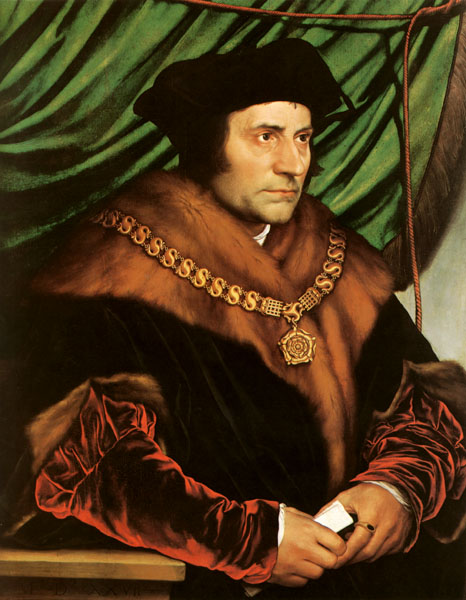
After a series of encounters and conversations at the Modernity Conference I recently attended, I was left thinking about the role of reason, particularly public, practical reason, in a polity, and the Church's role in rational discourse. A central question we face as a society is: What is reason, and what does it require of me, and of us? Pope Benedict's lecture at Regensburg is a recent locus for this conversation, but I've been interested in the intersection (or antinomy) of divine folly and public reason. Thus I picked up Peter Ackroyd's biography of Thomas More, who as Lord Chancellor and martyr of England is famous both for his reason and for his foolishness. I wanted to write a longer paper about More for an upcoming conference, but I really don't think I will have the time, so here are some scattered thoughts so I can at least explore some of my ideas in a much less formal context.

Pope Benedict briefly addressed the issue of faith and public reason in his first encyclical, Deus caritas est:
After a series of encounters and conversations at the Modernity Conference I recently attended, I was left thinking about the role of reason, particularly public, practical reason, in a polity, and the Church's role in rational discourse. A central question we face as a society is: What is reason, and what does it require of me, and of us? Pope Benedict's lecture at Regensburg is a recent locus for this conversation, but I've been interested in the intersection (or antinomy) of divine folly and public reason. Thus I picked up Peter Ackroyd's biography of Thomas More, who as Lord Chancellor and martyr of England is famous both for his reason and for his foolishness. I wanted to write a longer paper about More for an upcoming conference, but I really don't think I will have the time, so here are some scattered thoughts so I can at least explore some of my ideas in a much less formal context.
Pope Benedict briefly addressed the issue of faith and public reason in his first encyclical, Deus caritas est:
(28)(a) Justice is both the aim and the intrinsic criterion of all politics. Politics is more than a mere mechanism for defining the rules of public life: its origin and its goal are found in justice, which by its very nature has to do with ethics. The State must inevitably face the question of how justice can be achieved here and now. But this presupposes an even more radical question: what is justice? The problem is one of practical reason; but if reason is to be exercised properly, it must undergo constant purification, since it can never be completely free of the danger of a certain ethical blindness caused by the dazzling effect of power and special interests.
Here politics and faith meet. Faith by its specific nature is an encounter with the living God—an encounter opening up new horizons extending beyond the sphere of reason. But it is also a purifying force for reason itself. From God's standpoint, faith liberates reason from its blind spots and therefore helps it to be ever more fully itself. Faith enables reason to do its work more effectively and to see its proper object more clearly. This is where Catholic social doctrine has its place: it has no intention of giving the Church power over the State. Even less is it an attempt to impose on those who do not share the faith ways of thinking and modes of conduct proper to faith. Its aim is simply to help purify reason and to contribute, here and now, to the acknowledgment and attainment of what is just.
The Church's social teaching argues on the basis of reason and natural law, namely, on the basis of what is in accord with the nature of every human being. It recognizes that it is not the Church's responsibility to make this teaching prevail in political life. Rather, the Church wishes to help form consciences in political life and to stimulate greater insight into the authentic requirements of justice as well as greater readiness to act accordingly, even when this might involve conflict with situations of personal interest. Building a just social and civil order, wherein each person receives what is his or her due, is an essential task which every generation must take up anew. As a political task, this cannot be the Church's immediate responsibility. Yet, since it is also a most important human responsibility, the Church is duty-bound to offer, through the purification of reason and through ethical formation, her own specific contribution towards understanding the requirements of justice and achieving them politically.
While More's England is a world apart from any state today, his life clarifies what Benedict means by reason, which is not the instrumental reason of many economists or today's rational choice theorists. Consider the purification of reason, its freedom from ethical blindspots and the glitter of power or prestige. What's first striking about More is his seeming lack of ambition, the lightness with which he could take off his Great Seal, abasing himself after being the second most powerful man in England.
More's devotional life prepared him for his graceful fall from power. An enthusiast of The Imitation of Christ and like literature, he strove to be free of all attachment to earthly allures. His austere penitential practices, such as the hair shirt he wore under his flashy robes, while jarring to modern minds, trained him to check his own passions, so that he could serve his king and country unimpeded. Thus, while Thomas a Kempis wrote Imitation firstly to novice monks, More employed his themes in politics. The penance a Kempis prescribes is not that one must shun all material pleasures and possessions because they are intrinsically evil, but rather that we must purify our own desire so that we can pick up the ephemeral trappings of this world and rule them, rather than letting ourselves be ruled by them. More's detachment made him a pure-hearted counsel to the king, for he could offer advice without scheming for personal advantage.
On the other hand, his actions made him appear a fool, for he put so little stock in temporal glory that, when he could not go on as Lord Chancellor in good conscience, he willingly resigned, to the embarrassment of King Henry. Now to modern sensibilities, this act looks exceedingly foolish; even More foresaw his martyrdom, and prepared his somewhat begrudging family accordingly. Benedict's claim, when he insists that reason must not be hindered by power or personal interests, is that reason requires faith in order to pick up temporal business and handle it justly. In the process, secular issues do not cease to be secular, and arguments from divine law are inadmissible in public discourse or policy making (N.B. indeed our situation today may lead us to different conclusions on this matter than those More would have come to). Natural law, however, including the knowledge of God accessible to reason without special revelation, must be proposed. Faith serves the common good that politics seeks by purifying reason, by reminding citizens of their responsibilities (whether personal or public), and by forming consciences.
How does this impact us in twenty-first century America?
First, More sets a high standard for all citizens, especially Catholics, and especially politicians. His life shows that it is possible to live a very secular life very well. A Saint Thomas More of our time and place would, naturally, look very different. What would remain the same is a conception of reason that seeks not personal advantage, but truth and justice. With President Ford's recent death, we remember the only president who was never elected. I don't know much about Ford's life, but I expect one could draw some sharp contrasts between his ascendancy and that of so many politicians who rise through the sweat of their own ambition. The past two decades have shown us that scandal is an equal-opportunity devil; neither party, especially when it is in power, has escaped it. Character, More reminds us, is paramount for a politician. Yet character is not fundamentally about whether someone is a good family man or whether he or she lied in the last campaign; it's about whether or not my compatriots can rely on me to seek justice sincerely, if my desires are right and free. This, in addition to a keen intellect, experience, and other such characteristics, is necessary for politicians (not just Catholic politicians). It is also quite rare. With so many scandalous falls from power, it would be refreshing, though unfortunate, to see someone fall from power as graciously as did Sir Thomas More; such a figure, I trust, would inspire citizens for generations, indeed centuries, by revealing how divine folly can serve as public reason. In this way, More's life purified the reason of many by challenging general notions of civil power and politicians, showing that one can hold office devoutly.
Second, Benedict's point (less More's life) requires us to consider what kinds of arguments about public policy we make. Do we seek to impose the content of divine law on a nation, merely translating religious-ethical convictions into public policy or promoting Christianity in particular in schools or government? Rather, we should encourage reasonable dialogue and examine precepts of our faith in light of knowledge attained from a variety of disciplines. Thus we might escape from fundamentalisms of either the religous or the secular sort.
Subscribe to:
Posts (Atom)
The art of empathy in dramatic times
Over the past few years, my wife Christina and I have gotten involved in local theater (in the audience only - no auditions...yet!). I love ...
