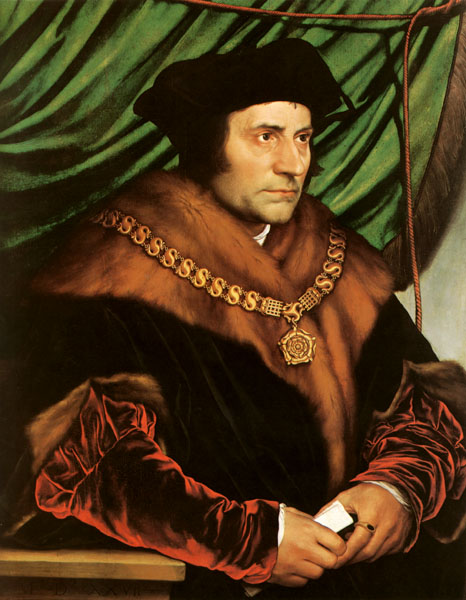
After a series of encounters and conversations at the Modernity Conference I recently attended, I was left thinking about the role of reason, particularly public, practical reason, in a polity, and the Church's role in rational discourse. A central question we face as a society is: What is reason, and what does it require of me, and of us? Pope Benedict's lecture at Regensburg is a recent locus for this conversation, but I've been interested in the intersection (or antinomy) of divine folly and public reason. Thus I picked up Peter Ackroyd's biography of Thomas More, who as Lord Chancellor and martyr of England is famous both for his reason and for his foolishness. I wanted to write a longer paper about More for an upcoming conference, but I really don't think I will have the time, so here are some scattered thoughts so I can at least explore some of my ideas in a much less formal context.
Pope Benedict briefly addressed the issue of faith and public reason in his first encyclical, Deus caritas est:
(28)(a) Justice is both the aim and the intrinsic criterion of all politics. Politics is more than a mere mechanism for defining the rules of public life: its origin and its goal are found in justice, which by its very nature has to do with ethics. The State must inevitably face the question of how justice can be achieved here and now. But this presupposes an even more radical question: what is justice? The problem is one of practical reason; but if reason is to be exercised properly, it must undergo constant purification, since it can never be completely free of the danger of a certain ethical blindness caused by the dazzling effect of power and special interests.
Here politics and faith meet. Faith by its specific nature is an encounter with the living God—an encounter opening up new horizons extending beyond the sphere of reason. But it is also a purifying force for reason itself. From God's standpoint, faith liberates reason from its blind spots and therefore helps it to be ever more fully itself. Faith enables reason to do its work more effectively and to see its proper object more clearly. This is where Catholic social doctrine has its place: it has no intention of giving the Church power over the State. Even less is it an attempt to impose on those who do not share the faith ways of thinking and modes of conduct proper to faith. Its aim is simply to help purify reason and to contribute, here and now, to the acknowledgment and attainment of what is just.
The Church's social teaching argues on the basis of reason and natural law, namely, on the basis of what is in accord with the nature of every human being. It recognizes that it is not the Church's responsibility to make this teaching prevail in political life. Rather, the Church wishes to help form consciences in political life and to stimulate greater insight into the authentic requirements of justice as well as greater readiness to act accordingly, even when this might involve conflict with situations of personal interest. Building a just social and civil order, wherein each person receives what is his or her due, is an essential task which every generation must take up anew. As a political task, this cannot be the Church's immediate responsibility. Yet, since it is also a most important human responsibility, the Church is duty-bound to offer, through the purification of reason and through ethical formation, her own specific contribution towards understanding the requirements of justice and achieving them politically.
While More's England is a world apart from any state today, his life clarifies what Benedict means by reason, which is not the instrumental reason of many economists or today's rational choice theorists. Consider the purification of reason, its freedom from ethical blindspots and the glitter of power or prestige. What's first striking about More is his seeming lack of ambition, the lightness with which he could take off his Great Seal, abasing himself after being the second most powerful man in England.
More's devotional life prepared him for his graceful fall from power. An enthusiast of The Imitation of Christ and like literature, he strove to be free of all attachment to earthly allures. His austere penitential practices, such as the hair shirt he wore under his flashy robes, while jarring to modern minds, trained him to check his own passions, so that he could serve his king and country unimpeded. Thus, while Thomas a Kempis wrote Imitation firstly to novice monks, More employed his themes in politics. The penance a Kempis prescribes is not that one must shun all material pleasures and possessions because they are intrinsically evil, but rather that we must purify our own desire so that we can pick up the ephemeral trappings of this world and rule them, rather than letting ourselves be ruled by them. More's detachment made him a pure-hearted counsel to the king, for he could offer advice without scheming for personal advantage.
On the other hand, his actions made him appear a fool, for he put so little stock in temporal glory that, when he could not go on as Lord Chancellor in good conscience, he willingly resigned, to the embarrassment of King Henry. Now to modern sensibilities, this act looks exceedingly foolish; even More foresaw his martyrdom, and prepared his somewhat begrudging family accordingly. Benedict's claim, when he insists that reason must not be hindered by power or personal interests, is that reason requires faith in order to pick up temporal business and handle it justly. In the process, secular issues do not cease to be secular, and arguments from divine law are inadmissible in public discourse or policy making (N.B. indeed our situation today may lead us to different conclusions on this matter than those More would have come to). Natural law, however, including the knowledge of God accessible to reason without special revelation, must be proposed. Faith serves the common good that politics seeks by purifying reason, by reminding citizens of their responsibilities (whether personal or public), and by forming consciences.
How does this impact us in twenty-first century America?
First, More sets a high standard for all citizens, especially Catholics, and especially politicians. His life shows that it is possible to live a very secular life very well. A Saint Thomas More of our time and place would, naturally, look very different. What would remain the same is a conception of reason that seeks not personal advantage, but truth and justice. With President Ford's recent death, we remember the only president who was never elected. I don't know much about Ford's life, but I expect one could draw some sharp contrasts between his ascendancy and that of so many politicians who rise through the sweat of their own ambition. The past two decades have shown us that scandal is an equal-opportunity devil; neither party, especially when it is in power, has escaped it. Character, More reminds us, is paramount for a politician. Yet character is not fundamentally about whether someone is a good family man or whether he or she lied in the last campaign; it's about whether or not my compatriots can rely on me to seek justice sincerely, if my desires are right and free. This, in addition to a keen intellect, experience, and other such characteristics, is necessary for politicians (not just Catholic politicians). It is also quite rare. With so many scandalous falls from power, it would be refreshing, though unfortunate, to see someone fall from power as graciously as did Sir Thomas More; such a figure, I trust, would inspire citizens for generations, indeed centuries, by revealing how divine folly can serve as public reason. In this way, More's life purified the reason of many by challenging general notions of civil power and politicians, showing that one can hold office devoutly.
Second, Benedict's point (less More's life) requires us to consider what kinds of arguments about public policy we make. Do we seek to impose the content of divine law on a nation, merely translating religious-ethical convictions into public policy or promoting Christianity in particular in schools or government? Rather, we should encourage reasonable dialogue and examine precepts of our faith in light of knowledge attained from a variety of disciplines. Thus we might escape from fundamentalisms of either the religous or the secular sort.


No comments:
Post a Comment