The art of empathy in dramatic times

Over the past few years, my wife Christina and I have gotten involved in local theater (in the audience only - no auditions...yet!). I love the thrill of live theater - the uniqueness of the experience and its presence in the moment. Last Monday, we were at the Huntington Theatre's "Spotlight Spectacular." At our table, we were discussing the Huntington's current show, The Who and the What (by Ayad Akhtar), about a Pakistani father and two daughters who immigrated to the United States. Like other of Akhtar's plays (most notably Disgraced), this show presents a rather critical view of Islam, especially with respect to gender roles and women's autonomy. With no strong counterbalance to this theme, the play left some in the audience uncomfortable, thinking that the play would only reinforce stereotypes about Islam for non-Muslims in the audience.


Someone at our table brought up that even beyond Islam, theater has a fraught relationship with religion of all stripes - indeed, it's rare to see a positive portrayal of religion on a modern stage. Given the rich and moving themes of world religions - mercy, reconciliation, peace, self-sacrifice, love, and many other values truths central to the human experience - the animosity between stage and steeple is unfortunate. Theater is always a reflection today's reality, which is complex - while I don't expect to see explicitly Christian stories on Broadway anytime soon (except the recent revival of Les Mis), I think the art community has an opportunity to re-present enduring themes in a modern context.

That got me reflecting on the response of the local theater community after Donald Trump was elected. How good are the arts at representing truly diverse worldviews, including those that the artist or audience find distasteful? In a November 9th article in the Boston Globe, local theater companies reacted to the election with fear. Paul Daigneault of the Speakeasy Stage Company saw in the election a "parallel to the Boston Marathon bombing or September 11." Shawn LaCount of Company One Theatre, whose "initial reaction was tears," doubled down on his vision of providing "safe space for powerful art and inclusion like we've never had to before."

Other arts leaders were more measured, even seeing an opportunity to stretch themselves. David Dower of Arts Emerson felt challenged to expand his own understanding of diversity and inclusion: "I’ve been working around issues of diversity or inclusion my whole life. All of these things that we’re celebrating are being viewed in this election as evidence of what’s being lost in these other communities. It’s a divide that’s being reinforced by the work that I’m doing." Michael Maso of the Huntington put it well: "Part of our job is to heal the divide. Maybe we feel it a little more starkly this morning than we would have otherwise, but the responsibility is the same."

As Americans, we have two paths before us: we can either amplify the voices in our echo chambers or venture beyond our comfort zone, listen to others, and move our nation toward a more authentic community. Theater has an opportunity to become truly "inclusive", reaching out to ideas and personalities that have become anathema in blue-state urban environments - from the abandonment felt by a rust-belt worker who lost a job or the witness of a community of faith. Likewise, audiences of all stripes have a responsibility to let themselves be challenged by art. Good art is not something we "agree" or "disagree" with, but something that helps us grow in empathy - at a show, it's not just the cast who should put themselves in someone else's shoes.


*Boston residents 35 years old or younger - you should check out the Huntington's 35-below deal...just $30 to see any show! This is a great opportunity to see top-quality theater at a fraction of the cost!


Hiatus

Dear visitors,
Just to let you know, I've got a lot on my plate right now, so I am taking a break from my blog. If you want, please check back after Easter.
Thanks!
Ky

Tariq Ramadan, Swing Dancing, and the Village People

I had an eventful weekend, with highlights including swing dancing Friday night with a live band, distributing Valentine's Day gifts with my parish's confirmandi to the elderly at American Village, a nearby nursing home (they're affectionately know as "the Village People"), braving the cold for a couple runs, and plenty of relaxing. The nursing home visit was really quite good, and I'm thinking about offering to distribute ashes to the residents next Wednesday, because some were asking about that. They really enjoyed the visit.

I officially finished my course of "Beginners" Latin study, so I'm moving on to working my way through Caesar's De bello gallico. In the course of my study, I discovered that I really enjoy learning foreign languages, which has apparently become a hobby of mine. I'm thinking about returning to Knoxville next summer for a part time job that would leave me time to take a course in Spanish or German at UT. German would help me in grad school, but I've found I mostly know languages that other people I meet don't know. I often meet Spanish- or Italian-speakers from Europe or Central/South America, but I speak neither of those languages. To be more hospitable to the folks I meet in the states, I'd really like to learn one of those languages, even though neither would help me much in my future studies. After learning Latin, a more practical language might be a good step.

Finally, I've started reading Tariq Ramadan's Western Muslims and the Future of Islam (another great find in a used bookstore). For those who don't know, Tariq was received a faculty appointment at Notre Dame, only to be denied a Visa to the US after a lot of dilatory tactics at the Department of State. Reading his book, I'm very disappointed he couldn't be part of life at Notre Dame, because his goals resonate well with Notre Dame's. Both are attempting to articulate a method of expressing the fullness of their respective faiths in an often antagonistic culture. Surprisingly, I have found that the two people I'm most reminded of in reading Tariq are Professor MacIntyre (in his remarks on "Islam, Modernity, and Us") and Pope Benedict (in his insistence on reason). Tariq outlines, among the basic principles of Islam, that God is transcendent and creator; that his dominion, and that of his Revelation, is universal in scope; that all creation is "Islamic," that is, submissive to God's will, and thus a source of Revelation; and that human beings are incomplete and thus yearn for completion and fulfillment in God alone. Of course, though each of these themes have their counterparts in Christianity, there are substantial differences, also in the anthropologies and philosophies of Islam and Christianity, but Tariq's account of Islam is thoroughly reasonable. Naturally, he misunderstands Christianity in many of the ways I would expect him to, but so has Benedict "brusquely" treated Islam here or there. Let me offer one excerpt from Western Muslims:
A living faith makes it possible for the intellect to accept signs beyond simple elements of nature, and active reason makes it possible for faith to understand and also to acquire more self-understanding, and in that way to draw closer to the divine: "Of all the servants, those who know are those who are open to the intimate awareness of God." Blaise Pascal had an apt expression: "The heart has reasons that reason does not know," thus differentiating the two realms of faith and reason (even though this formula has often been--wrongly--reduced to an opposition between the emotional and the rational). From an Islamic point of view, the relationship between the heart (where the first longing, the first breath toward faith takes place) and the intellect (which responds to the call of this breath and takes up the quest) might rather be expressed this way: the heart has reasons that reason will recognize. Apart from the expression, the difference is profound.
I am eager to see Tariq's practical insights about Muslim life in Western Society, which he intends to expound in the second half of the book, after outlining the fundamental principles of Islam in the first. And I'm still kind of upset with the State Department.

The Dawkins Delusion

A friend of mine just sent me a link to this youtube video. If you've ever heard Richard Dawkins debunk belief in God, you might like this spoof, in which a character who sounds exactly like Richard Dawkins disproves the existence of, well, Richard Dawkins... (If this doesn't embed properly, you'll have to follow this link.)

Blood Diamond

Saturday night, I saw a very intense, but very well done, movie: Blood Diamond.

If you can handle so much gore (really, you're not supposed to be able to handle it), Blood Diamond conveys powerful themes. It effectively juxtaposes western comfort and abstraction with the hell on which it often depends. The opening scene, for example, flashes between a rebel raid on a Sierra Leon village and a three-piece-suit UN meeting on curbing the flow of conflict diamonds. The western response was farcically disproportionate to reality.

Basically, the movie was about exploitation: of civilians, of the land, of the poor. Often, movies about social justice issues turn out too Michael-Moore-esque, a fate that Blood Diamond avoids. It is not about blaming everyone in particular, or simply conveying a political message; rather, it examines the sordid reality we all inhabit, whether knowingly or unwittingly. In the course of the film, two of the three protagonist discovered how he or she exploited the agony of others; they lived off of hell, either by fueling it or sensationalizing it (through journalism). This they discovered not on a geopolitical level alone, but through their personal interactions with those around them. The third protagonist, one of the damned condemned to hell by forces beyond his control, shone as a ray of hope and redemption. The personal microcosm that made the movie so engaging resonated with my conviction that, when dealing with social justice issues, we must examine our own activity according to the principles with which we critique society: am I looking out for the weakest among us? do I welcome the marginalized among my neighbors? do I encourage others to freely and creatively use their gifts?

Final thought: the movie made me return to an excellent book I read over the summer: War, Evil, and the End of History by Bernard-Henri Levy. This was quite a find in a used bookstore a year ago. Henri-Levy, a French professor of philosophy, parachuted into some of the darkest conflict zones in the world (Angola, Burundi, Sri Lanka, Sudan, and Columbia). There, he interviewed suicide bombers, child soldiers, derelict civilians, and drug lords (it's from his book that I borrow the language of "hell" and "the damned" that I use above; they refer to a place or persons which have lost all meaning, all continuity with the past, all presence today, and all hope for the future). Henri-Levy's mission, as he discovered it in writing his book, was to give voice to those ghosts, not in general (westerners are fond of generalities, which are more comfortable and manageable than personalities), but in particular. In this way, he could give the people he met a small purpose and meaning in life, because someone else would listen to them. By having an audience, they discover their story. His "adventures," as he called them, also shook him out of the comfortable theories of the West by literally dropping him into a world where every neat philosophy he had ever taught went up in smoke. "Evil," in these conflict zones, is not an archaic religious idea, or an event overcome by democracy and human rights, or a matter of perspective; nor are passion and commitment always good, nor are the conquered always victims; evil is not an idea at all, but a reality, or, better yet, a non-reality, for it obliterates reality. It infects those with power, crushes those indifferent to it or powerless before it, enlists the naive, and negates everyone. Without warning, it destroys cities, towns, and families, leaving living ghosts to wander amid the rubble of their lives that will never be rebuilt. Without facing this "reality," we cannot understand redemption or envision its surprising possibility. I am thankful that a movie like Blood Diamond can put us, even for only two hours, in a world where our assumptions and values are sorely put to the test.

Minding Other People's Business

Why Do Good? Brain Study Offers Clues - Forbes.com

I came across this very interesting article in Forbes the other day. It reports a recent study on the neurophysiology of "altruism." The researchers designed an experiment to see what regions of the brain increased in activity in altruistic people, as opposed to selfish people, upon seeing something good happen to someone else. They hypothesized that the "warm and fuzzy" department would increase activity, that is, the region associated with pleasure and reward. This would support the belief I've often heard that all love and service is really self-serving; I help other people because it feels good, or because it gives me something to be proud about.

Surprisingly, the study found that it is not the reward system, but the system that responds to meaningful stimuli in the environment, which is active, for example, when I see something threatening to me. Under the constraints of the experiment, this region was much more active in those who exhibited unselfish than in those who were selfish.

What motivates people to do good, the study suggests, is not self-satisfaction, but a deep, even primal solidarity by which I identify with a neighbor, realizing that "that could have been me." I haven't read the full study, only the report in Forbes, but it leaves me with some new questions. Here are a couple.

What I would study if I were a neurologist:
1) What trains or cultivates the region of the brain in question so that one responds to situations others face? Personal tragedy? Service work?

2) "Altruism" (there must be a more profound word they could have used!) often moves us to make costly sacrifices. How do ascetic practices, such as fasting, affect this region of the brain?

3) How much depends on genetics? How much on the way a child is raised?

Anyway, I was pretty pleased to see that a new scientific study is challenging the widespread assumptions of rational choice theory. Perhaps it will turn out that humans are even biologically a bit deeper than modern economics suggests.

Natalie's Big Day

Natalie's Baptism

Finally! I've got photos up from Natalie's baptism (plus a few bonus photos from other times during her 7 weeks so far on this side of the womb.

International Blog of Mystery

After putting a counter on my blog a couple months ago, I was excited when, checking statistics yesterday, I discovered that my blog has been visited by two people each from Canada and Sweden!

In other news, I'm signing off today to go on retreat this weekend (I'm about ready for a retreat, too), so I won't post again until sometime next week.

Shout outs

Just a couple shout-outs before I get back to work.

A tip of the hat to the Colts, super-bowl bound finally. If you didn't see the game last night, it was a great one. We had an impromptu game watch party at my house last night, and it was much fun, so I think it might be a precursor to a Superbowl party two weeks from now!

Tip of the hat to my new favorite flight site, www.kayak.com, which searches hundreds of other flights to find you the best deals, emails you when better deals come up, and offers graphs of fare trends so you know when a good time to buy is. I got my ticket to Florida for my goddaughter Hana's first birthday party there, and I'm officially a fan.

Finally, a tip of the hat to being done with graduate school applications! The last one is officially stamped, sealed, and [being] delivered! For those who haven't been keeping up with my future plans, I'm applying to doctoral programs in theology at U of Chicago, Boston College, Fordham, and Marquette. Apps were due between December and February. I'm glad I don't have to think about applications for a while, but I feel like I'm back in high school; even though I'm not expecting to hear back from anywhere until early March, I am always eager to check the mail when I get home from work, just in case... I'll keep folks posted here as I hear back, especially if it's good news.

And now, back to work.

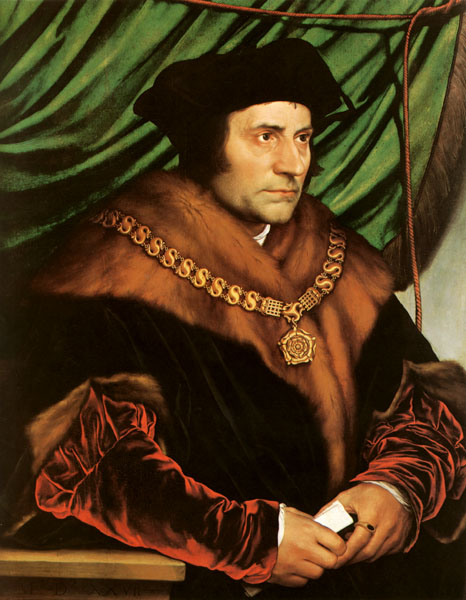
Sanctus Morus: Divine Folly as Public Reason

After a few personal notes in the last few posts, I guess it's time for me to post a meatier essay, but not before I assure you that Natalie Grace was baptized Sunday, and she did very well. I'll post pictures as soon as Aaron emails them to me.

After a series of encounters and conversations at the Modernity Conference I recently attended, I was left thinking about the role of reason, particularly public, practical reason, in a polity, and the Church's role in rational discourse. A central question we face as a society is: What is reason, and what does it require of me, and of us? Pope Benedict's lecture at Regensburg is a recent locus for this conversation, but I've been interested in the intersection (or antinomy) of divine folly and public reason. Thus I picked up Peter Ackroyd's biography of Thomas More, who as Lord Chancellor and martyr of England is famous both for his reason and for his foolishness. I wanted to write a longer paper about More for an upcoming conference, but I really don't think I will have the time, so here are some scattered thoughts so I can at least explore some of my ideas in a much less formal context.


Pope Benedict briefly addressed the issue of faith and public reason in his first encyclical, Deus caritas est:

(28)(a) Justice is both the aim and the intrinsic criterion of all politics. Politics is more than a mere mechanism for defining the rules of public life: its origin and its goal are found in justice, which by its very nature has to do with ethics. The State must inevitably face the question of how justice can be achieved here and now. But this presupposes an even more radical question: what is justice? The problem is one of practical reason; but if reason is to be exercised properly, it must undergo constant purification, since it can never be completely free of the danger of a certain ethical blindness caused by the dazzling effect of power and special interests.

Here politics and faith meet. Faith by its specific nature is an encounter with the living God—an encounter opening up new horizons extending beyond the sphere of reason. But it is also a purifying force for reason itself. From God's standpoint, faith liberates reason from its blind spots and therefore helps it to be ever more fully itself. Faith enables reason to do its work more effectively and to see its proper object more clearly. This is where Catholic social doctrine has its place: it has no intention of giving the Church power over the State. Even less is it an attempt to impose on those who do not share the faith ways of thinking and modes of conduct proper to faith. Its aim is simply to help purify reason and to contribute, here and now, to the acknowledgment and attainment of what is just.

The Church's social teaching argues on the basis of reason and natural law, namely, on the basis of what is in accord with the nature of every human being. It recognizes that it is not the Church's responsibility to make this teaching prevail in political life. Rather, the Church wishes to help form consciences in political life and to stimulate greater insight into the authentic requirements of justice as well as greater readiness to act accordingly, even when this might involve conflict with situations of personal interest. Building a just social and civil order, wherein each person receives what is his or her due, is an essential task which every generation must take up anew. As a political task, this cannot be the Church's immediate responsibility. Yet, since it is also a most important human responsibility, the Church is duty-bound to offer, through the purification of reason and through ethical formation, her own specific contribution towards understanding the requirements of justice and achieving them politically.

While More's England is a world apart from any state today, his life clarifies what Benedict means by reason, which is not the instrumental reason of many economists or today's rational choice theorists. Consider the purification of reason, its freedom from ethical blindspots and the glitter of power or prestige. What's first striking about More is his seeming lack of ambition, the lightness with which he could take off his Great Seal, abasing himself after being the second most powerful man in England.

More's devotional life prepared him for his graceful fall from power. An enthusiast of The Imitation of Christ and like literature, he strove to be free of all attachment to earthly allures. His austere penitential practices, such as the hair shirt he wore under his flashy robes, while jarring to modern minds, trained him to check his own passions, so that he could serve his king and country unimpeded. Thus, while Thomas a Kempis wrote Imitation firstly to novice monks, More employed his themes in politics. The penance a Kempis prescribes is not that one must shun all material pleasures and possessions because they are intrinsically evil, but rather that we must purify our own desire so that we can pick up the ephemeral trappings of this world and rule them, rather than letting ourselves be ruled by them. More's detachment made him a pure-hearted counsel to the king, for he could offer advice without scheming for personal advantage.

On the other hand, his actions made him appear a fool, for he put so little stock in temporal glory that, when he could not go on as Lord Chancellor in good conscience, he willingly resigned, to the embarrassment of King Henry. Now to modern sensibilities, this act looks exceedingly foolish; even More foresaw his martyrdom, and prepared his somewhat begrudging family accordingly. Benedict's claim, when he insists that reason must not be hindered by power or personal interests, is that reason requires faith in order to pick up temporal business and handle it justly. In the process, secular issues do not cease to be secular, and arguments from divine law are inadmissible in public discourse or policy making (N.B. indeed our situation today may lead us to different conclusions on this matter than those More would have come to). Natural law, however, including the knowledge of God accessible to reason without special revelation, must be proposed. Faith serves the common good that politics seeks by purifying reason, by reminding citizens of their responsibilities (whether personal or public), and by forming consciences.

How does this impact us in twenty-first century America?

First, More sets a high standard for all citizens, especially Catholics, and especially politicians. His life shows that it is possible to live a very secular life very well. A Saint Thomas More of our time and place would, naturally, look very different. What would remain the same is a conception of reason that seeks not personal advantage, but truth and justice. With President Ford's recent death, we remember the only president who was never elected. I don't know much about Ford's life, but I expect one could draw some sharp contrasts between his ascendancy and that of so many politicians who rise through the sweat of their own ambition. The past two decades have shown us that scandal is an equal-opportunity devil; neither party, especially when it is in power, has escaped it. Character, More reminds us, is paramount for a politician. Yet character is not fundamentally about whether someone is a good family man or whether he or she lied in the last campaign; it's about whether or not my compatriots can rely on me to seek justice sincerely, if my desires are right and free. This, in addition to a keen intellect, experience, and other such characteristics, is necessary for politicians (not just Catholic politicians). It is also quite rare. With so many scandalous falls from power, it would be refreshing, though unfortunate, to see someone fall from power as graciously as did Sir Thomas More; such a figure, I trust, would inspire citizens for generations, indeed centuries, by revealing how divine folly can serve as public reason. In this way, More's life purified the reason of many by challenging general notions of civil power and politicians, showing that one can hold office devoutly.

Second, Benedict's point (less More's life) requires us to consider what kinds of arguments about public policy we make. Do we seek to impose the content of divine law on a nation, merely translating religious-ethical convictions into public policy or promoting Christianity in particular in schools or government? Rather, we should encourage reasonable dialogue and examine precepts of our faith in light of knowledge attained from a variety of disciplines. Thus we might escape from fundamentalisms of either the religous or the secular sort.

Terminus adventis linguaque vivens

Well, I'm back after a week of no computers at my grandparents' house in Philadelphia. I was there with my sister and goddaughter, which was fun--lots of baby time. When I got to Knoxville last Sunday (just in time to fly to Philadelphia Monday morning), I got to put Hana to sleep because she was crying and Kris needed to pack. It took a while, and all the Advent and Christmas songs I know, but she finally fell asleep in my arms, which was pretty cool, and I made the transfer to the crib without a problem! Also, she gave me my Christmas present early--a "year of Hana Grace" calendar, entirely handmade by "Ma" (who wisely decided not to make it a page-a-day Hana Grace calendar!). Very well done, and I will proudly post it on my wall as soon as I return to Indianapolis.

It was good to spend some time with the grandfolks too, of course. Gran is recovering from a recent illness, so we didn't get out much, but it was good for her and Pa to see a lot of energy bouncing around their house in Kris, Hana, and me. It was also helpful to live at a slower pace that I normally do.

Tasks for my week at home before I (potentially) return to South Bend for New Years include finishing some grad school applications, searching for a fun summer job (post ideas in the comments thread), and working on some languages with my little brother. As far as summer jobs go, I'm looking either for something akin to a governors' school (as an RA), or for something adventurous and outdoors. Especially if I get into a PhD program for next year, an adventure summer would be refreshing. And as for languages, my Drew decided to teach me Arabic, and I'm teaching him Latin, which I insist is a living language. For example, did you know that Finland broadcasts its news in Latin, and has a news-in-brief on its EU Presidency site? And of course, Latin is the official language of the Vatican city-state.

Praise for Latin from the Economist

Finland makes Latin the King

Conspectus rerum Latinus (News from the EU Presidency)

Natalie Grace

Here are a couple photos of Natalie...

Goddaughter-elect

I got some very exciting news four o'clock yesterday afternoon--my goddaughter-elect, Natalie Grace, was born, an unexpected month early! The doctors say her vital signs are good even though she's only 4.5 pounds heavy (for comparison, I was a whopping 9 pounds, 7 ounces when I showed up a month late lo some 23 years ago). But the doctors say her vital signs are good, so they don't foresee any problems.

Conveniently, I was going Christmas shopping last night; I only ended up buying things for my godchild (Hana) and godchild-elect (Natalie), because they're the fun ones to shop for (but I'm on track and know what I need to get for everyone else). I'd write about the things I got them, because they're really cute and exciting, but I can't blog about them until after Christmas, in case they (or their parents) check blogs before then. ;)

The plan is to go visit Natalie tomorrow afternoon, and then go up again in a few weeks for the baptism. Ask my housemates, and you'll know that I'm a very proud godparent and love bragging about or showing off pictures of my little ones, so this is a very exciting time for me! (Sorry, no pictures yet; I'll try to post as soon as some arrive at my inbox).

Islam, Modernity, and Us

Still not sure if anyone actually reads this thing, but every now and then I get an email from someone referring to a post of several months ago, so I guess I should at least seasonally update my blog. Last weekend was quite busy for me; I was at Notre Dame for the Center for Ethics and Culture's annual fall conference, "Modernity: Yearning for the Infinite," then for our regional Communion and Liberation Advent retreat. So here is one reflection that struck me from the conference (although there are many more insights offered by speakers or in conversation that I won't be listing here). I may post a reflection from the second keynote, by Paul Griffiths, later this week or next.

First, the conference began with Professor MacIntyre's keynote, "Islam, Modernity, and Us." His provocative thesis was that when we talk about Islam, we're talking about ourselves, because we as Christians strive to engage modernity, which is ambivalent toward religious claims. While modernity is not irreligious, it offers a circumscribed space in which to practice one's faith, provided religion does not threaten the boundaries of other elements of modern life, such as politics and technology. In fact, modernity tends to fragment life, such that my work life is distinct from my personal life, and both from political or biological life; there is no public forum in which to ask what is the good for me, or for us, qua human beings, which religion tries to do. Instead, markets operate by independent, amoral norms; as for technology, what can be done may, indeed should, be done; and the limitations of our politics are taken as a given, even if perhaps modern democratic politics cannot adequately address today's most pressing issues. Each of these fields is taken as self-justifying and autonomous, without facing real, critical challenges in the public sphere (universities don't count).

As religions try to adapt to modernity, an easy impulse is to assimilate, accepting a truncated version of themselves that keeps them from genuinely challenging the established order. As believers become dissatisfied with restrictions on their freedom, they might rebel, rejecting the modern project altogether and seeking refuge in an ahistorical, fundamentalist version of faith (I'm reminded of the imam's city of halted clocks in Salman Rushdie's Satanic Verses). In promoting a purportedly pure, absolute faith, "the other" becomes evil, and violence ensues. These two options, I think, are the most common because they are easy. Religious people are either secularists dressed in religious garb, or artifacts enshrined in a museum, which lose their meaning because they have lost their context.

The via tertia (not a via media) that MacIntyre endorses seeks to create a space in which revelation is brought into conversation with reason and all the evidences at our disposal; a locus at which every aspect of my life can be discussed not as it relates to my prescribed, delineated roles, but as it relates to me, in a holistic sense. MacIntyre talked about a movement of Muslim women in Egypt who have begun gathering together to discuss ideas or their own conduct, even, for example, how they should dress in public. Each contribution to these meetings is expected to be defended rationally, yet they also insist on engagement with religious tradition. One can see these movements in the Catholic Church as well, such as in Communion and Liberation.

As to how these movements challenge the established order, I'm not sure. I don't think anyone should feel particularly threatened by the fact there are citizens taking their lives and actions seriously. But then again, they are radical precisely because they put on the table questions that might make me limit or revise my use of certain technologies, or my conduct at work, or I might just become a gadfly that puts a challenging question on the table now and then. What's truly revolutionary, however, is the change that such movements can accomplish in individuals; and every shift in character and identity has its ripple effect on communities. A friend asked me over lunch at the conference, if I were to found a revolutionary society, what cause I would choose, what I would fight against. My first thought was that I would wage a war against myself, a space where I could challenge myself and others to examine critically our lives and to make a real, persistent effort to live authentically, reasonably, and faithfully. This project is important for me because I find that it's much easier to identify and affirm the truth, than to care about it; and if I don't care, why should I expect others to? As far as my actions are concerned, only a change in me really change the world. Furthermore, finding peace within empowers us to advocate the right causes well, because we are freed from anxiety and insecurity about who we are.

Second, movements to dilate reason and begin a conversation with faith also make room for cross-cultural dialogue. As long as religion is invited to the table only after it is crippled by external restrictions, there is no room for dialogue, because religion will not be taken seriously. There is a toleration more dangerous than hostility, for some kinds of toleration allow me to think and say whatever I want, and people will tell me "That's an interesting thought," or "Good for you!", but will never accept a challenge that threatens their way of life; at least those who are hostile perceive, and must come to terms with, the offense. It's a goal of mine to take part some day in an interreligious network between Christian, Jewish, and Muslim movements that take faith and reason seriously, because a forum such as that is perhaps the best chance we have for true dialogue today.

Forgotten Wars

I've been reading a fascinating book by French philosopher Bernard-Henri Levy, who pretty much parachuted into five of today's worst warzones: Sri Lanka, South Sudan, Burundi, Angola, and Colombia (War, Evil, and the End of History). What distinguishes these wars is that, unlike our grand, world-shaping battles, they have no meaning. No battle for the soul of Islam, no clash of civilizations, no confrontation of ideologies. Rather, children are pressed into military service, and innocent people live aware that no one cares whether they live or die, nor will anyone know their fate. How will a massacre of a rural African village affect me? How will the success or failure of a rebel militia affect the course of world history? The global implications of battles involving the West and radical Islam are clear, or if not clear, at least certain. The forgotten wars, however, have no implications.

Sri Lanka has been in the news recently, because violence has re-erupted between the Tamils and the Sindhalese. I read an article about some Catholic priests who have been rushing around their village trying to protect civilians of all faiths (Christians are a small minority; the ethnic conflict is between Hindus and Buddhists, with neutral Christians and, believe it or not, Muslims caught in the crossfire of terrorism). A priest called out to the world, "We are heading towards an isolated, unknown and silent death. Are we going to be a people forgotten? Not cared for? Is the World going to keep silent now and count on our bones from mass graves to sit on judgment? How will the international community especially the European Union, Co-Chairs, and Peace envoys of Norway and Japan be indifferent when innocent, unarmed, people are systematically decimated." Apparently, one priest, who witnessed the massacre of 15 people he was sheltering in his Church, has recently disappeared.

As a catechetical minister in the states, this story struck me inasmuch as it contrasts with the ease of my ministry. I spend my time planning discussions on social justice, catechizing new Christians, or discussing Scripture with high school students at Starbucks. Surely these activities fulfill some needs of the Church where I am placed. But in Sri Lanka, ministers are doing all they can just to preserve life in an inescapable hell. It's tremendously difficult for me to imagine a genuinely life-or-death ministerial situation. I try to instill in all to whom I minister the conviction that they are created in the image of God, that their lives and choices have meaning and implications. How could I do that when faced with a society that utterly disregards human life, or a world that ignores the deaths of so many? How could I find God and show him to my parish when my people were living as a people damned--unnamed, forgotten, and of no consequence any longer?

While I can think of no practical responses I can initiate (any suggestions?), I do recall Paul's admonishment: "God has so constructed the body as to give greater honor to a part that is without honor, so that there may be no division in the body, but that the parts may have the same concern for one another. If one part suffers, all the parts suffer with it; if one part is honored, all the parts share its joy" (1 Corinthians 12:24-26). Events in the Sri Lankan Church are just significant as events in the American Church, where we concern ourselves with things of greater (practical) consequence, things that actually have effects; somehow I wonder if what happens in forgotten regions, where our voice is of no practical significance, is in fact of greater consequence, for our words and actions in those regions interrupt, however quietly, the darkness of hell. (I wonder: How is the work of Christians in those forgotten parts of the world perceived?) Who are we to say that pivotal events in our history are also pivotal eschatological, when perhaps the suffering of those abandoned to violence, of those remembered only by a God who seems not to care, is more eschatologically definitive. That is, our response to the forgotten might more deeply define our world and our humanity than does the outcome of the great wars going on today. I can't do much for the forgotten, but a first step is to practice greater solidarity, at least in prayer, with all "the damned," all those meaningless victims of meaningless violence, who cannot even console themselves that their annihilation--whether by physical death or dehumanization or utter loss of agency--is in service of some greater cause. I can at least listen to the voiceless, and begin to give them a voice....

More on Responses to Terrorism

open book: This is what bothers people

Hey, for those interested in more on the topic below, including a lot of voices who disagree with me, check out this post by Amy. You can also get a bonus post from me by scrolling down to my comment on her site.

Unjust Suffering and Just War

For those who are more loyal to this blog than I have been over the past three months (Dad), here's a new post after a busy summer of classes.

One of my most interesting classes this summer was on human suffering. We read a variety of theological texts, and surprisingly, not many dealt with questions that occupy us today. Even our professor, in designing the course, expected to consider the classic Humean question, "How can a benevolent God create a world in which evil exists?" Turning to texts in the Christian tradition, we discovered that a more pressing question for much of our history was "Why should Christians suffer more than everyone else?" and "What is Christian suffering?" Today, the question of theodicy weighs heavily on our shoulders today; no less urgent, however, are those ancient questions forgotten in our historic and religious amnesia: Why do the just suffer? How do we react to suffering?

The surprising answer that many authors proposed is that Christians should expect to suffer; in fact, if we're not suffering, we must ask ourselves if our faith is genuine and active. Christians, and all people who live justly, inevitably suffer in this world for two reasons. First, we are required to give up what looks like success to the worldly in pursuit of what is truly good. For example, a pregnant, unmarried teenager who opts to carry her child to term instead of aborting will likely have to abort her own hopes and dreams of success out of love for her child. Temptations to seek what is most advantageous to us crouch at the door, and in choosing the good, we lose our life; but only in dying out of love are we truly born to eternal life and happiness.

Second, we can be persecuted for choosing the good. For example, the woman who chooses to bear her child might be scolded by her boyfriend and parents and be ostracized by her friends. Partly these influences want what is advantageous for the girl they love, but their love is infected with anger and resentment toward one who would challenge them with a more perfect love. It's embarassing for human beings to see someone give her life completely for another, when human love is generally conditional. If you're successful, or if it's convenient, I will love you; there's always a limit to how much of myself I will share. Thus when we see Jesus's love revealed in his abasement and presence among the poor and accused, we initially seek his annihilation, or at least flee from him, afraid that his perfect love will expose our half-hearted charity.

So what does all of this have to do with just war? In a conversation at a wedding last weekend, a friend and I reflected on the crises in the Middle East. Given Hezbollah's clearly unjust tactics, like their use of civilians as shields, and their ambiguous juridical status, how is a modern nation to justly defend itself? In what ways is it permissible for a nation to defend itself against unjust tactics?

Several years ago, at the dawn of the Iraq war, I argued in a talk that, as a practical tool, just war doctrine must keep apace with developments in warfare; changing circumstances must affect our action, which is always action in context. For example, modern military capabilities might justify a preemptive strike against an imminent threat; but modern means of diplomacy, which must be exhausted before military action becomes licit, militates in the opposite direction and suggests that like capital punishment, war might become obsolete in modernity. You can read more at an article at PBS.com (actually, the article missed my thesis entirely, but I was still excited to be quoted at PBS).

My conversation last weekend led me to a further consideration. How effective should we demand just war to be? I realized talking points in defense of, say, Israel's action in Lebanon or America's action in Iraq, included a premise such as: "The only way for Israel to defend itself is to...." For example, the only way for Israel to defend itself is to accept (regrettably) collateral damage (high civilian casualties), because Hezbollah is using noncombatants as shields. Israel must defend itself, therefore it is just to incur high civilian casualties in modern warfare. Furthermore, inaction might lead to even higher civilian deaths from terrorism. (In response to this last point, we are obliged to protect civilians when possible, but we are not directly responsible for civilian deaths accomplished by other parties, as we are responsible for deaths caused by our own action. The question is what means of defense are just.)

The common argument outlined above assumes that justice and injustice are on equal footing. Justice should always be effective against injustice. Therefore, the only effective means of defense is by definition just. But where in life are justice and injustice on equal footing? If justice is always so successful, why is injustice so tempting? It is quite easy to cheat one's way through many difficulties, whether copying someone else's homework, practicing insider trading, or even murdering those who obstruct our prosperity. Injustice actually appears to be more advantageous than justice, because no means are barred. Justice limits our possibilities, but it ensures our integrity, even if it leads us to suffer. While we must always callibrate just war theory to our changing world, it is dangerous to assume that justice will always win. Rather, justice often requires great sacrifices. Once we realize that justice requires limits, our response to unjust tactics, such as using civilians as human shields, becomes clearer. A nation must defend itself, but it must do so justly. When we must choose to limit our means of defense to avoid collateral damage or to make ourselves more vulnerable, we may have to choose the latter.

Thus even today we may be martyred for the sake of justice. This fundamental aspect of Christian life and tradition appears to be far from our consciousness in our current intercivilizational crisis. But it is not just Christians for whom these reflections are relevant. Christ, our master, died a convicted felon, but so did Socrates. In fact, in Plato's "Republic," Socrates accepted Thrasymachus's challenge that the perfectly just man, to reveal that he loves the good for its own sake, must suffer and die in this world. Now is the time to recall that we pursue justice not for our success, but simpy for its own sake. The perfectly just will give up everything for justice.

(FYI, I don't really rise to this standard, but it's important to sketch the standard and examine
ourselves according to its logic. Our approach to the Good is a life-long journey that persists beyond our death. Nor do I expect most nations will be interested in holding themselves to a standard of justice; if leaders tried always to act justly, they'd probably be voted out of office quite quickly, although cynicism ought not blind us to those leaders who do seek justice.)

Immigration

With President Bush's recent speech on immigration, now is a good time to share my thoughts. I could go on and on (I just wrote a ten-page paper on immigration), but I'll try to be brief.

First, partisans on both sides of the immigration debate tend to fall into twin fallacies. Those hostile to immigrants claim that immigrants take jobs away from Americans, as though there is a fixed number of jobs to go around; an odd proposition in an period of economic growth and low unemployment.

In response, some, including our president on Monday night, claim that immigrants take jobs that Americans don't want. But are cities with low numbers of immigrants lacking in industries supposedly good (or poor) enough only for immigrants?

Opposed to these distortions, immigration has multiple interrelated impacts on our economy. Immediately, native unskilled workers do lose jobs or at least earn lower wages, consequent market laws; as supply of labor increases, wages drop. As wages drop, however, profit goes up, and as industries become more profitable, they attract increased investment. Demand thus belatedly catches up to supply as capital adjusts to an increased labor supply, and losses in wages are eventually offset. Consumers, of course, benefit from cheaper labor costs all along, but who really cares about them? Furthermore, stopping immigration will not save native wages, as long as we promote free trade and movement of capital, as we committed to in NAFTA. If immigrants do not come to America, companies will outsource more, lowering demand for labor at home; this has the same effect on wages as increased supply of labor.

The chief problem, as I see it, is how to help immigrants assimilate into our economy. They bring their own language, culture, and traditions, also leaving behind memories and families. Because immigrants are unfamiliar with our language and institutions, employers can easily exploit them; their ignorance, and sometime their undocumented status, bars them from protections American workers enjoy, such as unions and courts. We need to encourage immigrants to learn English, educate their children, and engage our own civil society, without forgetting the families and communities they left behind. Though this is a strain on our resources, it is necessary to fully integrate them into our economy, to which they contribute their labor. For their part, immigrants must make these priorities their own. Rewriting the Star Spangled Banner, for example, is unhelpful; statistically, those who remain in their comfort zone by socializing predominantly with other immigrants and not perfecting English skills take longer to assimilate--their wages take much longer to catch up with native wages than those of more ambitious immigrants.

Today's immigrants, like those of our past, have a lot to offer America. Rather than seeing them as a threat to our jobs, we need to welcome them into our communities and workplaces. I suspect that most immigrants are not greedily out to snatch jobs from deserving Americans. A dangerous journey across the Mexican-US border, leaving everything familiar in a trail of dust, betrays not a jealous, selfish whim, but desperation. People have a duty to support their families, and when conditions at home leave families in constant jeopardy, migration becomes a necessity. It is not surprising, therefore, that so many Hispanic immigrants have strong family values; communities promoting family values are a prophetic voice to our lonely, individualistic culture. From this perspective, people have not just a right, but a duty to migrate if they cannot obtain gainful employment to support their family at home. That so many individuals endure enormous social and personal costs to come to America illustrates their desperation and noble self-sacrifice, which our protectionist fears obscure.

Immigrants face a difficult task: they must remain faithful to their first home, while concurrently participating in a new social, political, and economic culture. As they work out their identity, our policies need to help them. This is not a purely altruistic proposal, because by bringing undocumented immigrants into our society more officially, we can regulate their activity in labor markets, monitor their assimilation, and collect taxes. At all levels, from government to friendship, ties between immigrants and natives need to be nurtured.

Finally, the resolve of immigrants is not just a nice human interest story. The volume of immigration from Mexico to America shows that economic conditions in some regions of Mexico are deplorable. People have a right to migrate if they must, but they should not have to. Employment should seek the worker, not vice versa, because immigration strains families and robs local communities of their human capital. The US, therefore, should partner with Mexico to increase investment in the poorest regions of Mexico. This would ease the immigration strain on both countries, especially for those who would have a real alternative to migration.

Lastly, I ought to add that it's nice to find an issue that can make friends out of a ecclectic group of interests, some sworn enemies. Here's something where leftists, big business, and Catholic bishops can all agree on. I just hope such an odd intersection of interests does not cause a traffic jam in Washington, in which good initiatives will run out of gas.

Shifts in Rome

Catholic and secular news sources have been reporting two imminent policy shifts in the Vatican: (1) Expanded permission to use the Tridentine rite to celebrate mass, and (2) Permission to use condoms in the fight against AIDS (a less likely possibility). I'd appreciate other perspectives on these issues.

Even though I find the Tridentine rite a bit inaccessible, I know people who find it very moving, and I think it has a lot to offer our Church today. First, many Catholics casually dismiss our history. Embracing Vatican II seems to imply rejecting what came before it as cold, distant traditions that could nourish faith. Yet dismissing history means we dismiss our ancestors as well, many of whom lived lives of profound faith animated by their participation in liturgy and parish and family life. Preserving the Tridentine rite today, not in old sacramentaries but as a coequal rite forming today's Catholics, can caution us not to expunge everything old, by demonstrating the enduring power of the liturgy. Similarly, the Tridentine rite can help us be sensitive to lacunae in our own Christian experience, by reminding us of aspects of liturgy that may have been lost in the reforms of Vatican II; some aspects of our worship may be more clearly present in the older rite.

For example, one of the most noticeable innovations in the new rite is the orientation of the priest; instead of facing "away from" the people, he faces toward them. This orientation makes many feel welcome members of a community, and perhaps helps the laity to participate more in liturgy. The old orientation, however, illustrates the nature of the community, in particular the relation between priest and congregation. The priest, acting in persona Christi caput, or in the person of Christ the head, addresses God with the people, who are the Church, the Body of Christ. Rather than facing away from the people, the priest faces God with the people. The Tridentine rite can remind us that liturgy is the prayer of the people, united in Christ, to God the Father.

On the second issues, condoms and AIDS, there are conflicting reports. Whatever is going on, I hope for a change of policy. As a general principle, contraception for the purpose of preventing pregnancy is wrong because it closes a married couple to the gift of life, and, therefore, to their own humanity; spouses aspire to give their entire selves to each other, yet they give everything except their noblest qualities--their ability to father and mother, to create, to sacrifice.... But general principles remain just that until they engage particular circumstances. It sometimes happens that, within a married couple, one spouse has AIDS and the other does not. The couple faces a choice: (1) Live a life of marital abstinence, (2) Almost surely transmitting AIDS, perhaps even to their children, and (3) Reducing the chance of transmitting AIDS by using condoms. The moral doctrine of double effect helps us distinguish this case from ordinary contraception issues. The doctrine reflects that, if an action has two effects, one good (A) and one bad (B), then it is morally permissible if and only if: (1) A, and not B, is willed, (2) The act itself is not objectively evil, and (3) A outweighs B. (1) is subjective and requires vigilance and well-formed consciences on the part of spouses. As for (2), some might claim that contraception is objectively evil, but it is rather the intent to restrict the gift of self, that is, the reservations a couple has, that are problematic. A single tool can be used for distinct purposes (for example, narcotics have both good and evil uses). Finally, A could outweigh B, especially if a couple expresses their openness to life in other ways, such as adoption. By maintaining these distinctions, the fundamental doctrine of our Church need not change.


Anyway, there are my thoughts on two current Church issues. Should these changes come to pass, I trust they will benefit our Church, and all those of good will. I also hope that people will be critical and honest enough to avoid misinterpreting either shift according to their own prejudices.

Moussaoui's Conversion

With Judgment, Moussaoui Is Silenced at Last | Chicago Tribune

I've been fascinated with the Moussaoui trial, which ended with a bang when he was sentenced last week, even if Moussaoui himself will not end with "a great big bang of glory," as Judge Brinkema noted, but with a whimper. The exchange between Moussaoui and Brinkema was interesting, even as Moussaoui himself remained enigmatic.

For a while I assumed Moussaoui, who was surprised to get a sentence for life, not for death, was seeking martyrdom. He clearly tried to project an image of a defendant in control, defying his defense attorneys and mocking the court. He even exclaimed, "This was my choice!" suggesting he somehow outwitted our justice system by evading a death sentence. Martyrdom, according to what I took to be his ideology, is a more attractive alternative to imprisonment, and he could easily spin that as a success. Yet he claims that he won, America lost, because he will not be executed. I take this to be a loss for him, since he fought so hard against himself and his own due process, yet he failed. Moussaoui continues to pretend he is in control, but this is more and more clearly a delusion; no hypothesis is good unless it can be disproved, but Moussaoui could justify himself no matter the verdict. If he were honest with himself, he would see that a life sentence proves him wrong. Instead, he lets his ideology defy the world, not in fact, but in his own estimation.

In his parting toast, Moussaoui called the trial a wasted opportunity for America to understand how people like him think, and to critically assess our own faults. Insofar as there is a major cultural gap between us and radical Islam, this is true. Yet Moussaoui's actions since his sentencing show that this gap is reciprocal. This leads us to what I can only call Moussaoui's (insincere) conversion.

A true judge, Brinkema astutely argued that not Moussaoui, but America emerged victorious:
This trial and this verdict are clear evidence of the enduring strength of this nation and its core values, which do not focus on hatred, bigotry and irrationality.

Rather, we believe that all persons are created equal and that when they appear in one of our courts of law, they will be treated as equals, regardless of their background or their political beliefs.
Only days after the sentencing, Moussaoui is converted to the judge's view. He now claims that he lied in court and wishes to retract his guilty plea. He did not believe he could get a fair trial in America; people would be ruled by emotions and calling for his blood. Now he understands that he can get a fair trial, "even with American jurors," and he repents of his former ignorance.

Apparently, he did not understand the regard America has for fairness and the rule of law. Although I agree that Moussaoui probably didn't appreciate American institutions, I doubt his new-found respect for them. My counter-proposal to his hypothesis is that he lost, and he wants a better consolation prize. At least his fate has finally led Moussaoui to, embarassingly, admit he was wrong. One can only hope that his contradictions don't dissolve in ideology, but precipitate a sincere conversion.

The art of empathy in dramatic times

Over the past few years, my wife Christina and I have gotten involved in local theater (in the audience only - no auditions...yet!). I love ...